Humans
The HumansHumans are the object of an alien’s field study and, gradually, its most consequential surprise. The Alien narrator begins by treating them as a physically strange, intellectually middling species on an isolated, water-covered planet. Yet the inquiry he undertakes—how humans live, what they do to one another, and whether their failings leave room for hope—becomes a test of his own assumptions. Humans matter not because the account resolves their contradictions, but because it shows those contradictions changing the observer.
Identity and First Impressions
The Alien narrator introduces humans as bipedal beings of moderate intelligence, living on Earth in what he initially considers a lonely and unremarkable region of the universe. He describes their faces and bodies as difficult for an outsider to accept, and their customs as no less bewildering. Human conversation, in his first assessment, often avoids what people actually want to discuss; body shame and clothing etiquette appear to him as elaborate, puzzling conventions.
That portrait is deliberately colored by prejudice. Before reaching Earth, the narrator has absorbed a compressed travelogue that characterizes humans as violent, sexually embarrassed, artistically inept, and prone to repetitive behavior. He knows the planet exists, but admits that no preparation could have made him ready for the encounter. When first confronted with spoken human language, he cannot understand it: he needs to hear roughly a hundred words before he can assemble its grammar. His difficulties establish the limits of his supposedly superior perspective. Humans are not immediately legible to him, and the observer’s confidence is no guarantee of understanding.
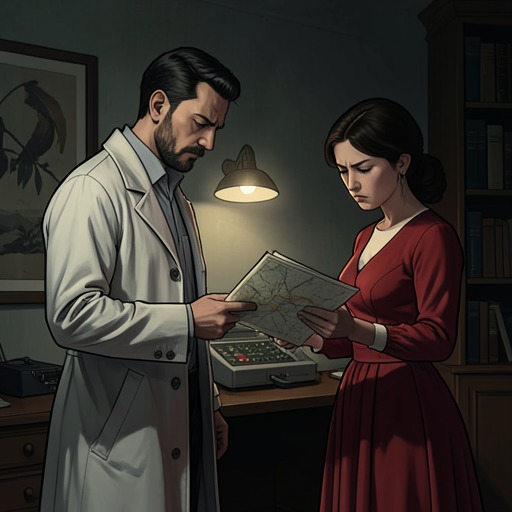
The book frames its human subject through a particular family and a mathematical crisis: a forty-one-year-old historian, Isobel Martin; her fifteen-year-old son, Gulliver Martin; and the world’s cleverest mathematician. The Alien narrator stresses that the account is about the meaning of life and its apparent absence, about saving as well as killing, and about how a being might become human. This framing makes the species more than an object of general description: human life is encountered through particular people and the consequences of their relationships.
Mortality and the Scale of a Human Life
The narrator measures human existence against the long-lived perspective of his own civilization. Humans have not solved death, yet most do not spend their lives in continuous terror of it. He estimates an average human lifespan at eighty Earth years, or about thirty thousand days, and compresses that duration into a sequence of ordinary possibilities: friendship, meals, marriage or its absence, children or none, wine, sex, regret, and the recognition that time has passed. The sequence ends in death and the loss of both space and time as individual experience.
This stark arithmetic does not make human lives seem empty in practice. The narrator observes that people continue to do things rather than remain immobilized by the knowledge of their mortality. The contrast between a finite lifespan and the persistence of everyday activity becomes central to his study: humans live with an ending they cannot prevent, but that knowledge does not wholly dictate how they spend the intervening days. Their vulnerability is therefore not only a defect in comparison with immortality; it is part of the condition the narrator is trying to understand.
Appearance, Nature, and the Work of Art
As the Alien narrator learns more, he interprets human life as divided between appearances and truth. Clothing initially seems inexplicably important; so do the transformations by which a dead cow becomes beef, a lawn becomes a space people are not meant to walk on, and a household animal acquires emotional significance. He concludes that humans seek reassurance through apparent mastery of nature. The lawn and the reshaping of wolves into dogs become examples of how they arrange the natural world according to human needs and meanings.
In this account, nature also becomes a figure for human nature. The narrator argues that civilization has required people to conceal parts of themselves, as if they had been dressed in metaphorical clothing and separated from an original self. Art—books, music, films, plays, painting, and sculpture—then functions as a bridge back toward what civilization has obscured. The bridge cannot erase the distance, but the effort to cross it helps explain why cultural expression matters to a species the narrator once dismissed as shallow.
Poetry marks a decisive opening in that dismissal. The Alien narrator discovers Emily Dickinson and takes her writing as an invitation to consider possibility rather than accept his first judgment. The account’s movement from ridicule toward attention is not a claim that art cures human confusion. Instead, art offers a way to approach experiences that direct explanation cannot settle, and it gives the observer a means to reconsider the people he was sent to assess.
Civilization and Its Contradictions
The narrator’s initial indictment is severe. He describes humans as arrogant, violent, and greedy, and argues that they have put their only accessible home planet on a destructive course. In his view, they make divisions and categories while overlooking their similarities, and pursue technological advancement faster than their psychology can mature. Money, fame, and the desire for advancement for its own sake appear to him as forces that magnify existing flaws.
He also warns himself against judging individuals in isolation from the harms of the species as a whole. A kind face, he reasons, does not remove a person from collective responsibility for human violence. This rule expresses the mission’s demand for detachment, but the narrative increasingly puts pressure on it: gathering information about humans means encountering particular lives, not merely assigning responsibility to an abstract species. The narrator’s growing involvement thus unsettles the very distance his task requires.
Human institutions and habits seem to him full of contradictions. People may praise peace while glorifying war, reject the idea that money buys happiness yet choose money, and condemn violence in one setting while honoring it in another. He characterizes human civilization as a system that has turned inward, feeding on its own consequences while failing to recognize the part its members play. These claims are the observer’s argument, not a neutral catalogue of every human being; their force comes from his effort to explain why technical dominance has not produced corresponding self-knowledge.
Knowledge, Technology, and the Possibility of Change
Human attempts to understand the universe offer the narrator another example of their mixed capacities. Astrophysicists estimate that life may exist on millions of planets, then confront the question of why extraterrestrial civilizations have not made contact. The narrator objects that the reasoning leaves out relevant factors. His response reveals a species capable of powerful mathematical and scientific inquiry, even as he sees it as too ready to mistake a simplified account for a complete one.
He contrasts Earth’s limited social networking with the brain-synchronization technology and shared dream experiences of Vonnadoria. Human networks, he observes, involve people using computers to exchange small reports about their needs while sometimes failing to act on those needs. Yet the same systems are, in his judgment, strikingly vulnerable: because their security relies on prime numbers, he can hack Gulliver Martin’s computer and alter the accounts of people who bullied Gulliver. His intervention is vindictive, and he experiences satisfaction in it—an action that shows his own conduct beginning to depart from the detached standards of his people.
The narrator’s deepest reconsideration concerns how knowledge changes its possessor. He argues that close study of physics, biology, neuroscience, mathematics, or love can unsettle what once seemed certain. On the scale of an individual life, a crisis may expose a belief as wrong; people often bury that discovery, and the denial gradually narrows their ambitions. Change, by contrast, demands courage or risks appearing like madness. The account’s final measure of humans is therefore not whether they are free of delusion, violence, or error. It is whether their capacity for art, inquiry, attachment, and change can make a life worth cherishing despite those failures—and whether the observer can learn to see that possibility.